white line

MNU Hosts Influencer Luncheon to Address Kansas Teacher Shortages 

 |
Pete Brumbaugh

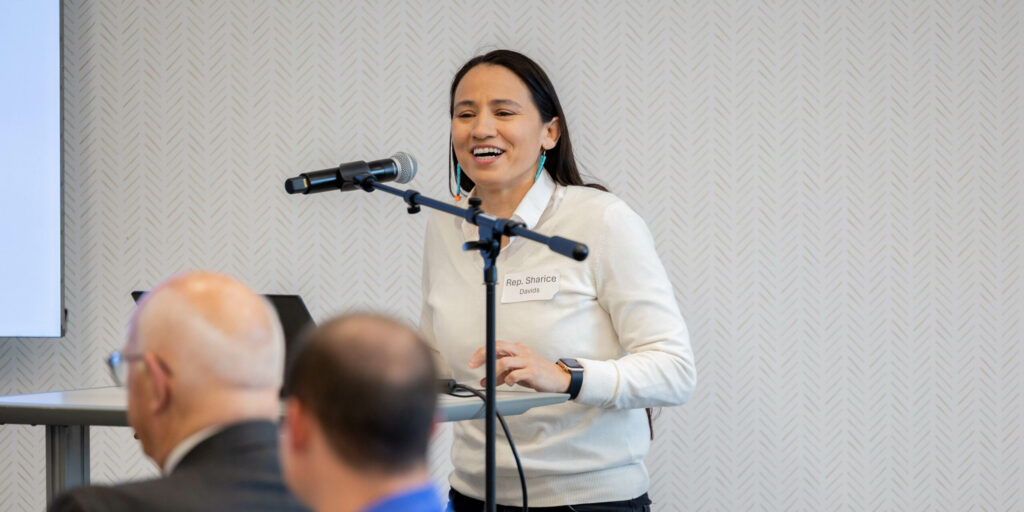
National, state, and local leaders gathered on the campus of MidAmerica Nazarene University last week to discuss challenges to public education and how MNU could be part of the solution to teacher shortages across Kansas and other states.  

Organized by Dr. LeEtta Felter, MNU trustee, and Dr. Jill Gonzalez-Bravo, associate dean for MNU’s School of Education, the first annual Education Influencers Luncheon attracted U.S. Representative Sharice Davids (D-KS); Kansas Education Commissioner Dr. Randy Watson, state and local legislators, and district administrators and principals from nearby school districts. 

“The event was the perfect opportunity for MNU to bring together education influencers to collaborate on the challenges and opportunities facing our local school districts and educators,” Felter said, “In a time that is challenging for most colleges and universities, this was an excellent opportunity for us to set MNU apart from all the rest and to show that we are true partners with our local school districts. I can’t help but believe that this will help with enrollment as we continue to innovate and bring value to our community.”  

Recent grads Carly (Diaz ’23) Burns and Jonas Pippitt (’21) spoke about their experience at MNU and their transition into the teaching profession. Burns is an elementary special-education teacher in the Olathe School District, while Pippitt is a high school math teacher in the Gardner-Edgerton School District and recently was honored with the Horizon Award for excellence among new teachers. 

“While we typically host our advisory board each fall and spring, this year we wanted to keep with our pioneering spirit and try something different,” said MNU’s Gonzalez-Bravo. “The goal of the event was to encourage those working to elevate the teaching profession and fuel innovations in recruiting and retaining effective educators.” 

One of the programs that may factor into addressing teacher shortages is MNU’s new Elementary Education-Unified degree. Particularly helpful for paraeducators serving in a school environment, the program helps students complete their teaching degree within 24 months. MNU is one of a handful of colleges and universities selected by the Kansas State Department of Education to provide this program. Paraeducators from regional districts may qualify for a generous $10,000 grant to assist them on their journey to becoming a teacher. MNU offers an additional $4,500 scholarship to qualifying students. The university also provided each district in attendance with an additional $1,000 scholarship to bless one of their employees pursuing this academic program. 

Special thanks to the following sponsors for their generosity in making this event possible: Clay & Janet Blair, the Ronald D. Deffenbaugh Foundation, the Felter Family Trust, Mark & Cynthia Rosenau, Martin & Wallentine LLC, and Weber Flooring.

Mar
2
We Love Alums Week
MNU Alumni & Friends Facebook and Instagram Pages
7:00 am

6:00 pm
Mar
7
Innovation Academy Invitational
MidAmerica Nazarene University - Cunningham Student Center
10:30 am

3:00 pm
Mar
7
MNU Concert Band | From Sea to Sky
Bell Cultural Events Center - Mabee Performing Arts Hall
6:00 pm

7:00 pm
Mar
8
MNU Choirs | Messiah
Bell Cultural Events Center - Mabee Performing Arts Hall
3:30 pm

5:30 pm

Featured News

Purpose Found Through Unexpected Detours
Trey Larimer arrived at college with a clear plan—and a problem. He wanted to help people, and he...
Purpose Found In Faith, Family And Folks
Sam Riley’s life is proof that transformation doesn’t always come quietly.

Dr. Abby Hodges

Vice President for Academic Affairs

PhD; Organic Chemistry, Yale University 
MS; Organic Chemistry, Yale University 
BS; Chemistry, Denison University

Dr. Hodges began her career in higher education at Azusa Pacific University as a chemistry professor from 2008 to 2014. She then moved to MNU where she taught and in 2018 was appointed Chair of the Department of Natural, Health, and Mathematical Sciences. From 2022-2023, before accepting the Interim Vice President for Academic Affairs, Dr. Hodges was the Dean of the College of Arts and Sciences.

Dr. Hodges’ career research has focused on protein folding and protein engineering, and she has mentored over twenty students in these research projects. She has also furthered the MNU first-year experience program and chaired the General Education committee for five years. Dr. Hodges was recognized as the MNU Faculty of the Year in 2021.

Dr. Hodges lives in Olathe with her husband Ryan and two boys.

University Cooperative Program

Advantages of the MNU & Washington University School of Engineering and Applied Science cooperative program:

  • 3+2 Option: Students spend 3 years at MNU and then transfer to WashU for 2 years to earn an undergraduate engineering degree from WashU and a bachelor’s degree from MNU, or
  • 3+3 Option: Students spend 3 years at MNU and then transfer to WashU for 3 years to earn an undergraduate engineering degree from WashU, a bachelor’s degree from MNU, plus a master’s in engineering from WashU.
  • Combines the best of MNU with the strength of a top engineering school
  • Students participating in the 3+3 options receive a 50-60% tuition discount at WashU
  • GRE is not required for admission

To qualify for entry into the program at MNU students must:

  • Enter the program at MNU at the beginning of the freshman year through the application process
  • Maintain an overall GPA of 3.25 or better in science and mathematics courses
  • Meet regularly with the MNU pre-professional committee

To qualify for program completion at WashU students must:

  • Complete all General Education requirements at MNU
  • Complete a minimum of 90 credit hours of transferable college credit
  • Complete the following courses:
    • Chemistry: one semester of general chemistry with lab
    • Computer Programming: One course or certified proficiency in a high-level language
    • English Composition: One course or certified proficiency
    • Humanities and Social Sciences: At least 15 hours (see WashU website for specific prerequisites)
    • Mathematics: See WashU website for specific prerequisites
    • Physics: One year calculus-based physics with lab
  • See WashU website for department-specific prerequisites

To learn more about program offerings at MNU and degree specific prerequisites, visit engineering.wustl.edu/dualdegree

Other restrictions and qualifications may apply.

For additional information, contact Craig Masters at cmasters@mnu.edu