white line

Once-In-A-Lifetime African Adventure

 |
Carol Best

Article and photo contributor, Dr. Rion Taylor

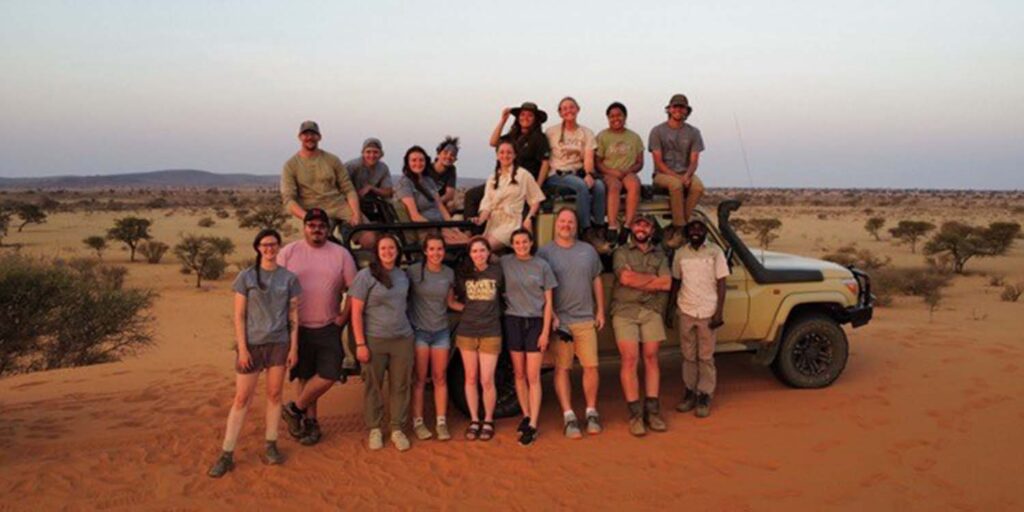
In August 2024, Dr. Rion Taylor, professor of biology, and students from the Department of Natural, Health and Mathematical Sciences traveled nearly 9,000 miles to southwest Africa for MNU’s new African Field Studies course. The course is offered in collaboration with Olivet Nazarene University (ONU). Partnering with ONU Professor Dr. Nick Troendle, 14 undergraduate students from both universities studied African wildlife and ecology up close. 

The group’s expedition began at Victoria Falls, one of the world’s largest waterfalls. It is also a biodiversity hotspot with many species found nowhere else. The adventure continued with safari-style visits to several diverse ecosystems ranging from wetlands to savannah to desert. The course ended with a stay at a local game reserve where students learned about conservation and conducted original research projects.
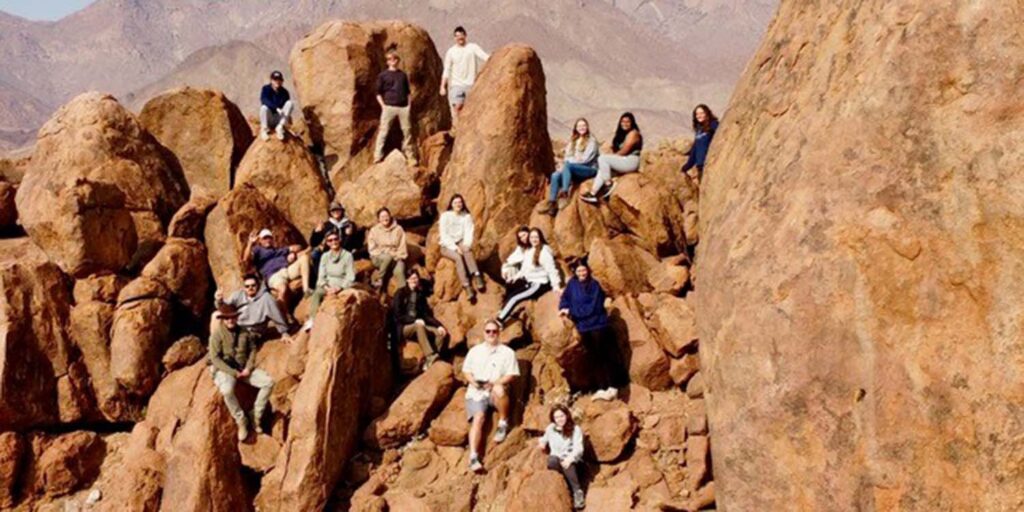
Students posed in rock formation in Africa

According to Dr. Taylor, learning in this incredible part of the world with an amazing group of students was a highlight of the trip. One especially memorable experience was a once-in-a-lifetime, up-close encounter with a mother elephant and her calf. Taylor said the group will never forget the rhinoceros herd that approached their trucks. Getting to know the incredible local guides who accompanied the team was also a highlight. One guide has served as a guide for the BBC’s “Planet Earth” documentary series.

“One of my best experiences was helping to feed the rhinos,” said Nick Allen, senior kinesiology major. “I was so close that I could have run over and touched one of them if I had the courage. But I got nervous when our guide said, ‘Just keep your eyes on him (the rhino) so you know when you have to run.’”
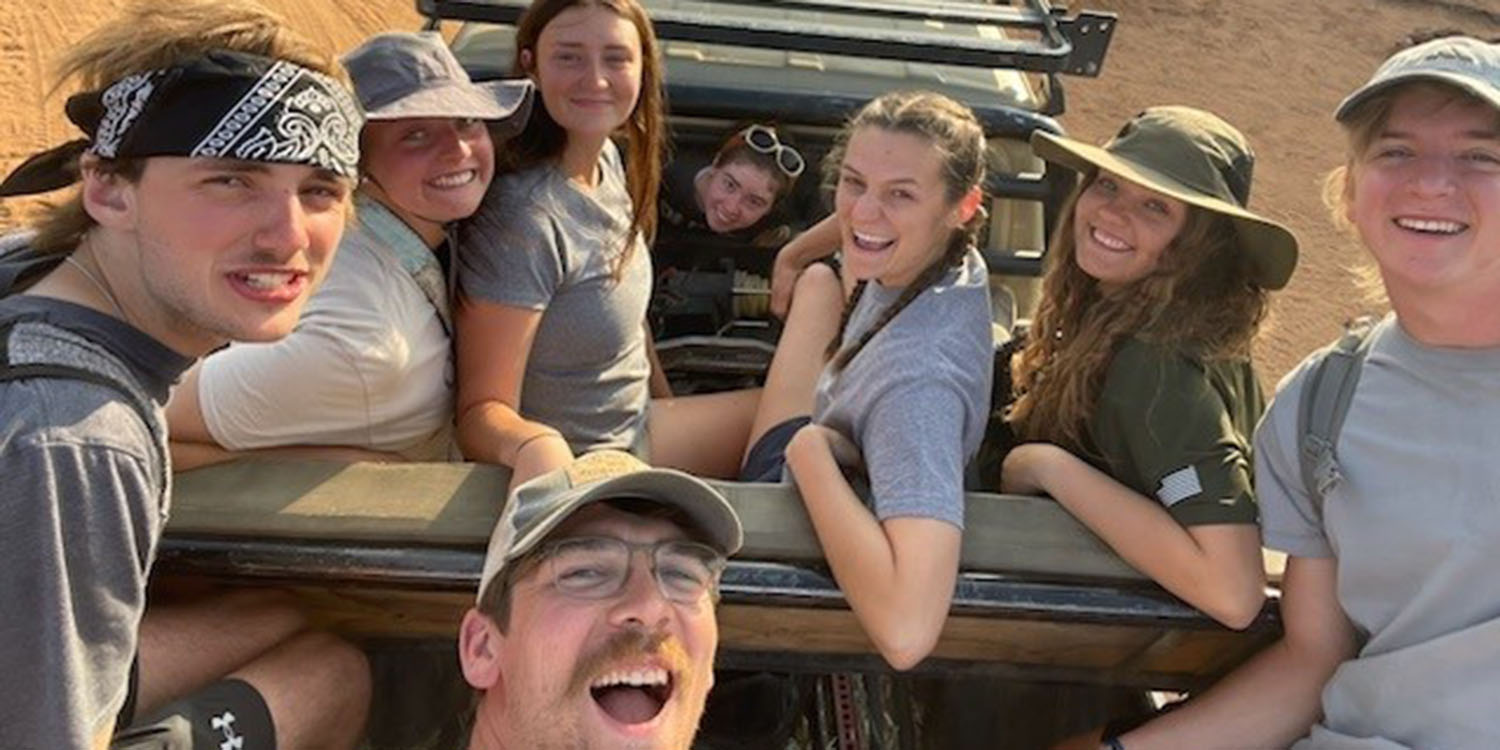
Students prepare for more safari-like adventure.

Senior biology major Hailee Thompson found new relationships. “My favorite part was talking with all the new people,” she said. “People who share the same passion for biology and conservation. That was so cool. We’re immediate friends.”

Interspersed with these experiences, the group enjoyed local food, evening campfires, and a thrilling ride through the desert dunes. Some members of the expedition group even decided to bungee jump or skydive.

The group ended each day by recounting lessons learned, marveling at God’s creation, stargazing, and singing praise songs.

“We would meet in the evenings to share “praises and prayers” which was nice because it showed all of us a different side of each other,” said Katie Sinclair, senior MNU biology major. Dr. Taylor added, “It was especially impactful when the guides joined us for our evening sessions. To see people of all ages and from vastly different places worshiping together was very moving.”

African Field Studies (BIOL 3803) seeks to connect the academic and spiritual aspects of scientific discovery. It is offered during the summer of even years, and groups spend 14 days in Africa. To help sponsor a student for the next offering of this course, please contact Dr. Rion Taylor at rgtaylor@mnu.edu.

Enjoy more photos of the African adventure on MNU’s Flickr album.

Dec
12
Chorus Kansas City | Gloria!
Bell Cultural Events Center - Mabee Performing Arts Hall
7:00 pm

8:30 pm
Dec
13
December Virtual College Affordability Seminar
Online
10:00 am

11:00 am
Dec
13
Fountain City Brass Band | Bells-a-Plenty
Bell Cultural Events Center - Mabee Performing Arts Hall
7:30 pm

9:30 pm
Jan
4
KCMTA - Multi Piano Concert 2026
Bell Cultural Events Center - Mabee Performing Arts Hall
3:00 pm

4:00 pm

Featured News

MNU’s 20th Annual Martin Luther King, Jr. Community Celebration
Rev. Darryl Answer will receive the Martin Luther King, Jr. Living Legacy award at MNU's 20th Annual Community...
Rachel Marlow’s Purposeful Journey from Student to Kansas Teacher of the Year
Each time Rachel Marlow (MEd ’15) enters her music classroom at Central Elementary in Olathe, she brings not...

Dr. Abby Hodges

Vice President for Academic Affairs

PhD; Organic Chemistry, Yale University 
MS; Organic Chemistry, Yale University 
BS; Chemistry, Denison University

Dr. Hodges began her career in higher education at Azusa Pacific University as a chemistry professor from 2008 to 2014. She then moved to MNU where she taught and in 2018 was appointed Chair of the Department of Natural, Health, and Mathematical Sciences. From 2022-2023, before accepting the Interim Vice President for Academic Affairs, Dr. Hodges was the Dean of the College of Arts and Sciences.

Dr. Hodges’ career research has focused on protein folding and protein engineering, and she has mentored over twenty students in these research projects. She has also furthered the MNU first-year experience program and chaired the General Education committee for five years. Dr. Hodges was recognized as the MNU Faculty of the Year in 2021.

Dr. Hodges lives in Olathe with her husband Ryan and two boys.

University Cooperative Program

Advantages of the MNU & Kansas City University of Medicine and Biosciences partnership program:

  • Students spend 3 years at MNU and 4 years at KCU
  • Requirement for Medical College Admission Test (MCAT) is waived
  • Students graduate with a degree from both institutions (B.S. from MNU and D.O. from KCU)
  • The Program is available at both Kansas City and Joplin campuses

To qualify for entry into the program at MNU students must:

  • Enter the program at MNU at the beginning of the freshman year through the application process
  • Have a minimum ACT score of 28
  • Participate in community service
  • Have a dedication to the field of osteopathic medicine
  • Meet regularly with the MNU pre-professional committee

To qualify for program completion at KCU students must:

  • Complete all General Education requirements at MNU
  • Complete a minimum of 99 hours of course work at MNU
  • Maintain an overall GPA of 3.25
  • Maintain a science coursework GPA of 3.5
  • Participate in KCU-Com’s weeklong Summer Learning Enhancement Program
  • Complete the following course with a grade of “C” or higher at MNU:
    • Biological Sciences 12 hours
    • Chemistry 13 hours
    • Biochemistry 3 hours
    • Physics 8 hours
    • English Composition 6 hours


Other restrictions and qualifications may apply.

For additional information, contact Rion Taylor at rgtaylor@mnu.ed