white line

Digital Communication

Bachelor of Arts

Digital Communication prepares students for digital media and content creation careers by implementing message design and delivery.
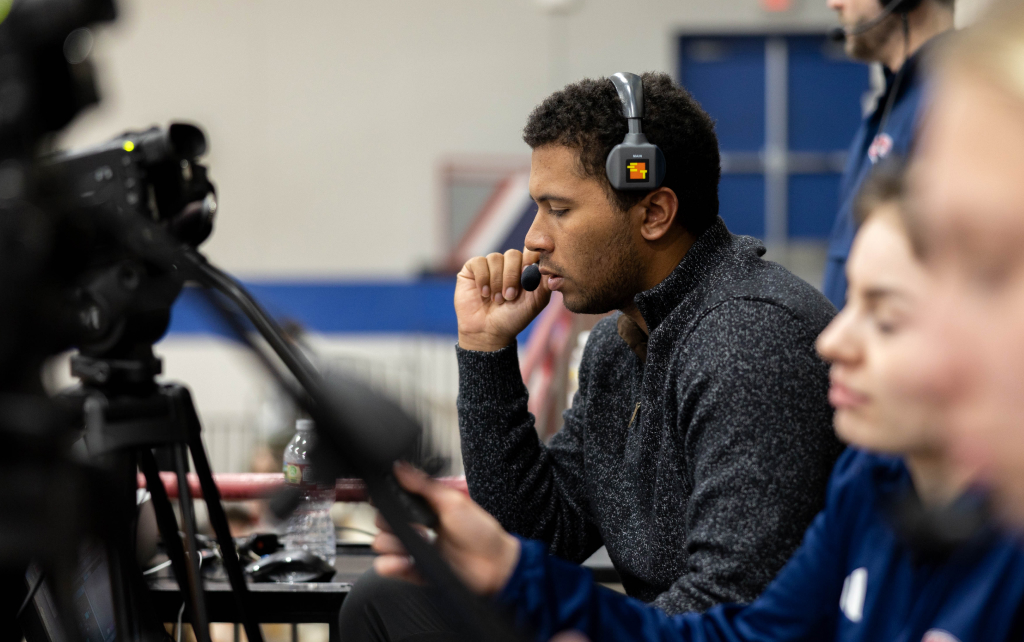
Student operating a sound board at a sports game

Fast Facts

Meets on-site in Olathe
126 credit hours

We Prepare You

The Digital Communication major prepares students for digital media and content creation careers by creating and implementing message design and delivery across all industries. Graduates might work in film and video production, sports media production, audio and live production, podcasting, broadcasting, news media, programming, content creation and curation, digital marketing, social media, management, search engine optimization, and marketing direction.

Program Overview

Want to make an impact? A degree in Digital Communications helps you find your creative voice and use it to shape culture and community. Learn to craft, deliver, and evaluate strategic messages through hands-on coursework and real-world experience. An internship will provide valuable experience, build your digital portfolio and prepare you for your career.

Every industry—business, media, nonprofits, healthcare, and more—needs skilled digital communicators.

Available tracks:

  • Film & Video Production
  • Sports Media Production
  • Audio & Live Production
  • Management
  • Entrepreneurship
  • News Media
  • Programming

View all courses & admission requirements

Create a sample schedule

Cost & Value

A degree from MNU is a competitively priced, affordable option designed for students with a busy schedule. We’re here to help you find the best options to assist you as you work toward earning your degree.

Credit Hours:

General Education: 42-50

Major Requirements: 45

Electives: 16-26

Total: 126

Financial Aid Available

The Federal Direct Student Loan Program is an additional payment option. MNU School Code: 007032. Information and applications may be obtained from the Student Financial Aid Services Office at 913.971.3298 or finaid@mnu.edu.

Pioneer Pledge

Concern about paying back student loans is common. That’s why we provide the Pioneer Pledge, our loan repayment assistance program. If your income is modest after graduation, Pioneer Pledge assists with your educational loan repayments. Learn more on our financial aid pages.

MNU Scholarships

Your education is one of the most important investments you will ever make. At MNU nearly 100% of new students qualify for financial assistance that greatly reduces the actual cost of an MNU education.

Payment Options

Your degree is an investment in your future. We have a variety of different payment options available, so you can choose the option or combination of options, that best fits your situation. The total cost will be calculated based on your program and can be divided into multiple payments.

Application Process

Fall 2025 Start

Now accepting applications from seniors in high school or college transfers who are interested in starting at MNU in Fall of 2025.

Fall 2026 Start

Now accepting early action application from juniors in high school! Applicants with a cumulative high school GPA of 3.75 (weighted or unweighted) will be considered for provisional admission with priority consideration for our honors program and performing arts scholarships.

*Some exceptions made on case by case basis

Prospective students will need to provide:

Complete an MNU application
Submit all transcripts
Complete a FAFSA. MNU code: 007032

Navigate Your Business Journey

Find the program that’s right for you. Talk to your MNU team to customize your journey.

Dr. Abby Hodges

Vice President for Academic Affairs

PhD; Organic Chemistry, Yale University 
MS; Organic Chemistry, Yale University 
BS; Chemistry, Denison University

Dr. Hodges began her career in higher education at Azusa Pacific University as a chemistry professor from 2008 to 2014. She then moved to MNU where she taught and in 2018 was appointed Chair of the Department of Natural, Health, and Mathematical Sciences. From 2022-2023, before accepting the Interim Vice President for Academic Affairs, Dr. Hodges was the Dean of the College of Arts and Sciences.

Dr. Hodges’ career research has focused on protein folding and protein engineering, and she has mentored over twenty students in these research projects. She has also furthered the MNU first-year experience program and chaired the General Education committee for five years. Dr. Hodges was recognized as the MNU Faculty of the Year in 2021.

Dr. Hodges lives in Olathe with her husband Ryan and two boys.

University Cooperative Program

Advantages of the MNU & K-State Cooperative Program:

  • Exposure to graduate-level courses not offered at MNU
  • Opportunity for an accelerated pathway for a master’s degree from K-State Olathe
  • Access to additional professional development resources offered through K-State

To qualify for program entry at MNU students must:

  • Be a junior or senior at MidAmerica Nazarene University
  • Be majoring in biology or similar field
  • Maintain a 3.5 GPA or higher
  • Have the recommendation of MNU faculty

To qualify for program entry at K-State students must:

  • Complete a minimum of 75 hours of undergraduate degree prior to applying for program
  • Complete a minimum of 90 hours of undergraduate degree prior to attending K-State classes
  • Provide a short essay detailing why the student wants to participate in the advanced sciences program
  • Complete the application process

Other restrictions and qualifications may apply.  For more information visit https://olathe.k-state.edu

For additional information, contact Jill Speicher at jspeicher@mnu.edu

University Cooperative Program

Advantages of the MNU & Kansas City University of Medicine and Biosciences partnership program:

  • Students spend 3 years at MNU and 4 years at KCU
  • Requirement for Medical College Admission Test (MCAT) is waived
  • Students graduate with a degree from both institutions (B.S. from MNU and D.O. from KCU)
  • The Program is available at both Kansas City and Joplin campuses

To qualify for entry into the program at MNU students must:

  • Enter the program at MNU at the beginning of the freshman year through the application process
  • Have a minimum ACT score of 28
  • Participate in community service
  • Have a dedication to the field of osteopathic medicine
  • Meet regularly with the MNU pre-professional committee

To qualify for program completion at KCU students must:

  • Complete all General Education requirements at MNU
  • Complete a minimum of 99 hours of course work at MNU
  • Maintain an overall GPA of 3.25
  • Maintain a science coursework GPA of 3.5
  • Participate in KCU-Com’s weeklong Summer Learning Enhancement Program
  • Complete the following course with a grade of “C” or higher at MNU:
    • Biological Sciences 12 hours
    • Chemistry 13 hours
    • Biochemistry 3 hours
    • Physics 8 hours
    • English Composition 6 hours


Other restrictions and qualifications may apply.

For additional information, contact Rion Taylor at rgtaylor@mnu.ed