white line

MNU Researchers Target Threat to Bees

July 21, 2025 |
Carol Best
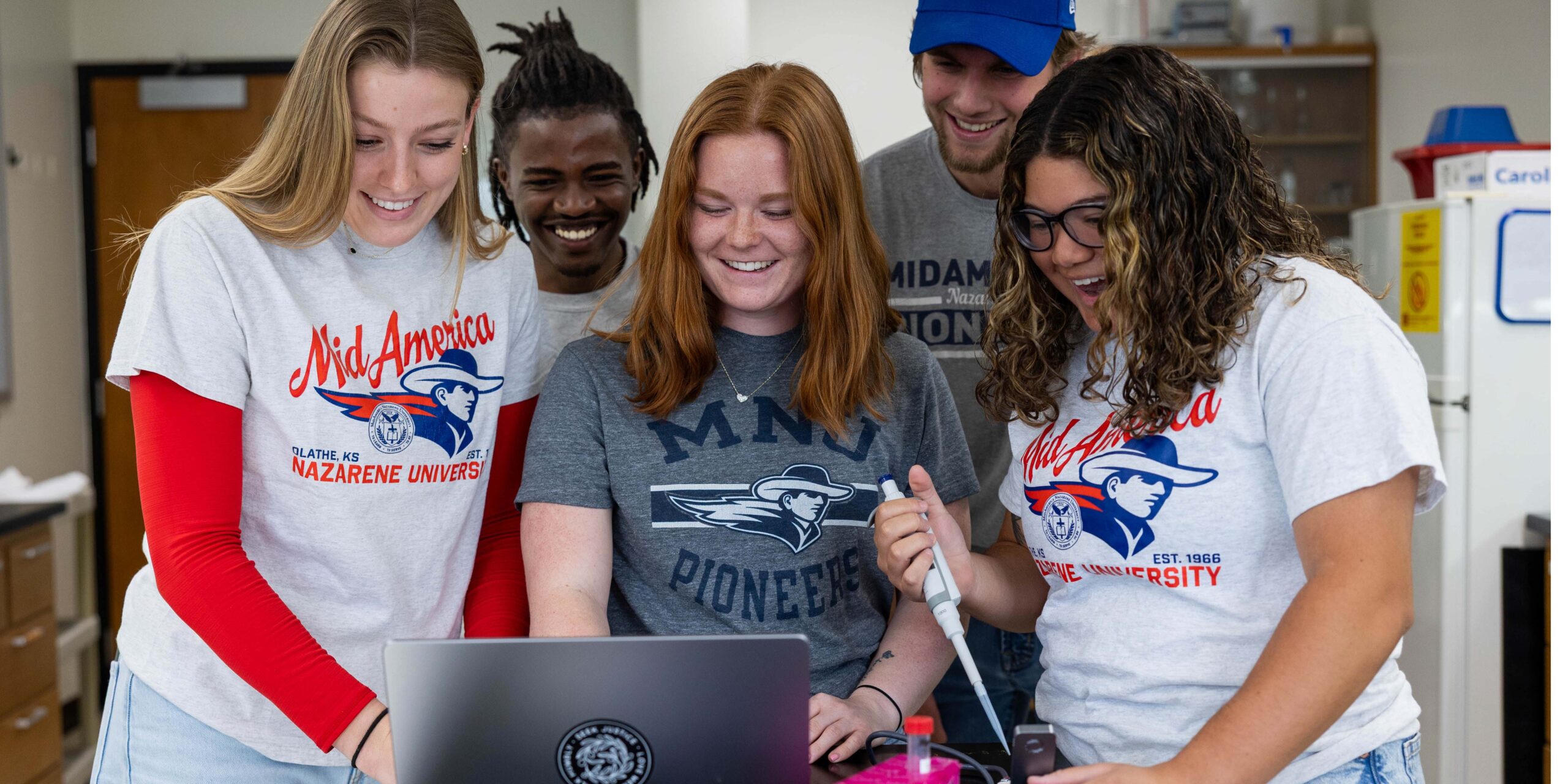
Students in lab learning to sequence DNA of bees and mites
MNU students are learning to sequence the microbiomes of honeybee hives to combat deadly mite infestations. L to R: Hayley Loewen, James Mwihaki, Paige White, Aidan Thomas, Elayna Goff.

In a busy corner of a MidAmerica Nazarene University science lab, students are helping solve a problem that affects food supplies worldwide. With guidance from the Barkman Endowed Professor of Science, Dr. Rion Taylor, they are sequencing the metagenome of honeybee hives to learn how to protect these vital pollinators from one of their deadliest threats: Varroa destructor mites.

Honeybees are among the world’s essential pollinators, responsible for about one-third of the food we eat. However, in recent years, bee populations have declined, partly due to the parasitic Varroa mite, which weakens and can ultimately destroy entire colonies. By studying metagenomic DNA, the researchers hope to identify genetic markers linked to mite resistance or vulnerability—information that could one day lead to more effective treatments or breeding strategies.
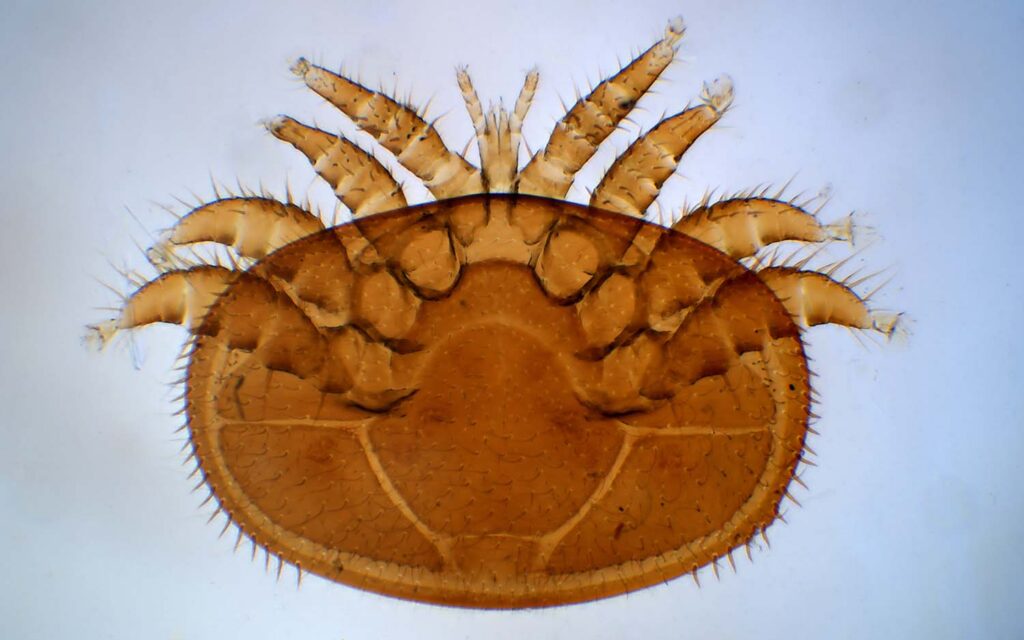
Varroa Destructor Mite
Parasitic Varroa destructor mite under the microscope.

“The mites feed on honeybees’ fat body and hemolymph, which is similar to our liver and blood,” Taylor says. “They also transmit a host of diseases that contribute to colony collapse. It can be difficult to treat a mite-infested hive. As mites and honeybees are closely related from a phylogenetic perspective, finding treatments that target just the mites is challenging.”

Research Significance

By sequencing the metagenome (study of genetic material from an environmental sample) of honeybee hives the students in Taylor’s research group hope to help find a way to target treatment that will harm the mites but not the bees. Taylor says there are medications that treat the infestation, but mites are becoming resistant to them.
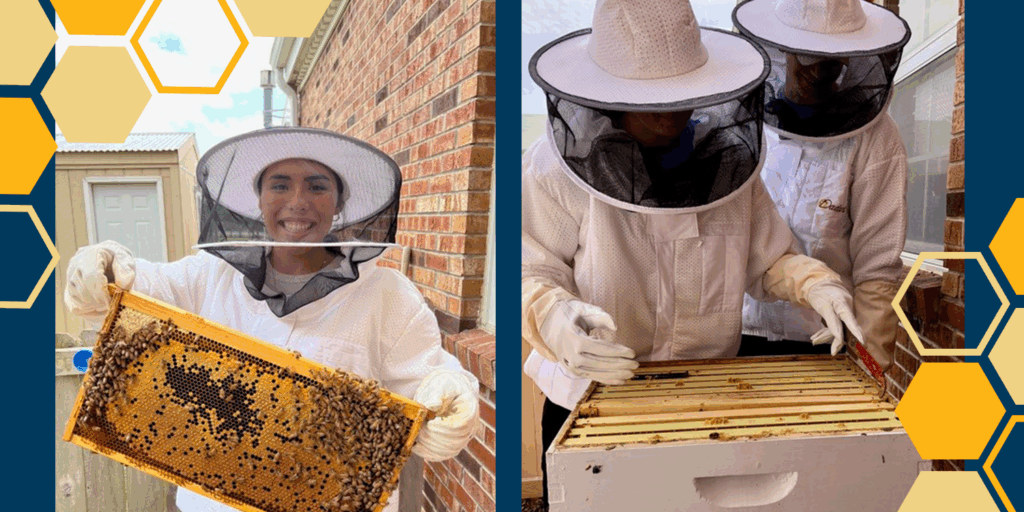
Student in beekeeping garb holding honeycomb and two students in beekeeping garb with the hive.
MNU’s Apiary (a place where beehives are kept) and colony of bees were a 2017 gift from MNU Alums Brent and Lynette Barkman of Barkman Honey, one of the country’s top honey producers and distributors. As part of their generous support of MNU, the Barkmans have established two endowed professorships at MNU in the field of science. Shown here are MNU students learning beekeeping.

“We want to see if there are any differences between the bacteria that the honeybees have associated with them and the bacteria that the mites have,” Taylor says. “If the mite has bacteria that it needs to survive and the honeybee does not have that bacteria, we can target the mite’s bacteria with antibiotics to kill that specific bacteria, thus killing the mite. This approach is known as selective toxicity.”

Making Advanced Research Possible at MNU

At many small universities, the kind of DNA sequencing underway in Dr. Rion Taylor’s lab would be out of reach. Until recently, such technology was prohibitively expensive—often requiring institutions to outsource samples to large sequencing facilities, which meant delays and lost educational opportunities.
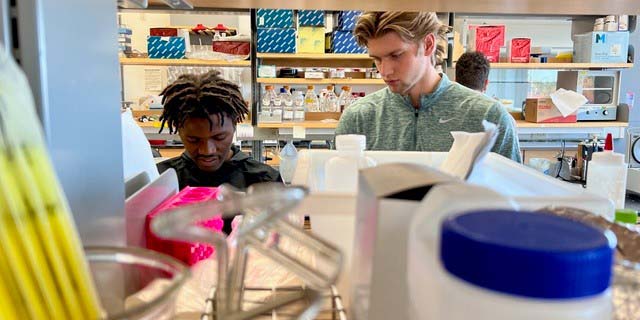
James Mwihaki and Aidan Thomas working in MNU lab on DNA sequencing
James Mwihaki and Aidan Thomas working on DNA sequencing.

“Just a few years ago, you’d need $250,000 to $400,000 just to get started,” said Dr. Taylor. “Now the equipment is more affordable, but the training and expertise still aren’t easy to come by. That’s what makes this experience so remarkable for our students.”

Thanks to generous support from the Barkman family, longtime MNU donors, the university was able to acquire sequencing equipment and provide the training needed to use it effectively. Dr. Taylor and two students traveled to the University of Wisconsin–Madison to work with one of the top bioinformatics labs in the country—an opportunity that equipped the students to analyze the sequencing data themselves. The funding also made it possible to bring a DNA sequencing expert to MNU’s campus to train students and faculty on the sequencing process.
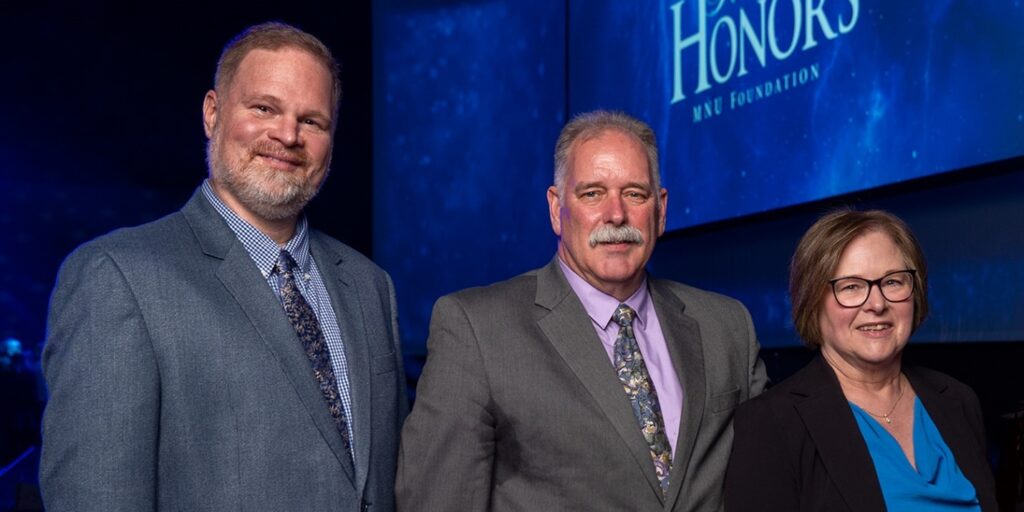
Rion Taylor, Brent and Lynette Barkman photo at President's Honors gala 2025.
Dr. Rion Taylor with Brent and Lynette Barkman

This rare combination of resources, mentorship, and real-world experience allows MNU undergraduates to engage in meaningful genetic research—something typically reserved for graduate students at large research institutions.

Benefits Beyond Today

Taylor has more plans to implement DNA sequencing in other science classes and research projects. He thinks the technology may also be used to benefit students in different fields. For example, MNU’s criminology students might be able to learn first-hand about how DNA sequencing works and gain insight into its uses for solving crimes.

As the students and Taylor make progress in their DNA sequencing project, they hope their work contributes to the growing body of research aimed at protecting honeybees. One day, this work may help beekeepers build more resilient hives, which can ultimately contribute to the diversity and sustainability of the global food supply.
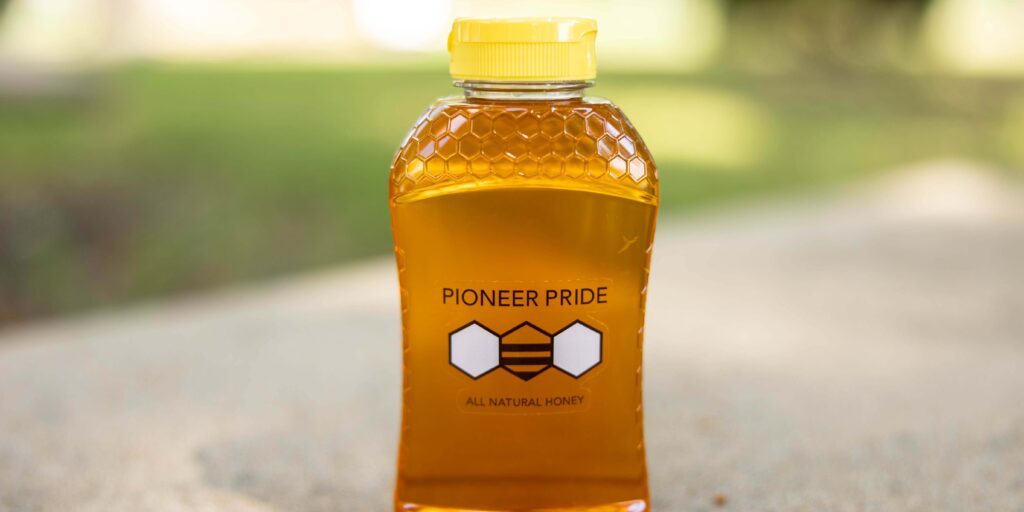
A bottle of Pioneer Pride honey.
MNU students also learn to extract honey.

Learn about MNU science opportunities at mnu.edu/undergraduate-stem-studies.

Nov
18
MNU Jazz Ensemble | Java Jazz 2025
Bell Cultural Events Center - Mabee Performing Arts Hall
7:30 pm

9:00 pm
Nov
19
Performing Arts Preview
Bell Cultural Events Center
3:00 pm

9:00 pm
Nov
21
MNU Theatre | Student Directed One Acts
Bell Cultural Events Center - Sunderland Black Box Theatre
7:30 pm

9:30 pm
Nov
23
MNU Chamber Orchestra | Pops and Praise
Bell Cultural Events Center - Mabee Performing Arts Hall
3:30 pm

4:30 pm

Featured News

MidAmerica Nazarene to Inaugurate Dr. Jon D. North as its Sixth President Nov. 18
MidAmerica Nazarene University is proud to announce the inauguration of Dr. Jon D. North as the sixth president...
MNU Remembers Dr. James H. Diehl, Sr., General Superintendent Emeritus of the Church of the Nazarene
MidAmerica Nazarene University joins the global Church of the Nazarene in marking the passing of Dr. James H....

Pioneer Football

Dr. David Spittal​

President

EdD; Educational Administration (Higher Education/Public Relations), Ball State University
MSE; Music, Ball State University
BS; Music & Art Education, Ball State University

Dr. David Spittal has been the president of MidAmerica Nazarene University since 2012. Under his leadership, the university is striving to reach the next level of God-honoring excellence.

Prior to coming to MNU, Dr. Spittal served as president of Southern Wesleyan University in Central, S.C., from 1994 to 2011. During his 17-year tenure, the university experienced historic growth and expanded to five campuses and learning centers. His work led SWU to strengthen and build relationships with the local and regional community.

An influential member of the local community, Dr. Spittal serves on various councils and boards including the Council of Advisors of the Olathe Chamber of Commerce and the Board of Trustees for the Kansas Independent College Association and Kansas Independent College Fund. He is a member of the USA/Canada Council of Education of the Church of the Nazarene.

He and his wife Donna have two grown sons and six grandchildren.

University Cooperative Program

Advantages of the MNU & Cleveland University-Kansas City Cooperative Program:

  • Accelerated pathway to becoming a Doctor of Chiropractic Medicine
  • Acceptance into Cleveland for all students who complete appropriate coursework at MNU with a cumulative GPA of 3.00 or higher.
  • Specialized advisor for students of MNU who intends to pursue professional study at Cleveland.

To qualify for program entry at MNU students must:

  • Desire to pursue a career in Chiropractic Medicine
  • Major in Kinesiology

To qualify for program entry at Cleveland students must:

  • Complete an application to Cleveland 6 months in advance of desired entrance date.
  • Complete a minimum of 99 hours of an undergraduate degree at MNU.
  • Maintain a 3.0 or higher cumulative GPA
  • Complete all coursework as outlined in the agreement between MNU and Cleveland.

Other restrictions and qualifications may apply.

For additional information, contact Leigh Kreshel at lakreshel@mnu.edu

University Cooperative Program

Advantages of the MNU & Southwest Baptist University Cooperative Program:

  • Preference points on application into a highly competitive program.
  • Mission alignment between Southwest Baptist University and MNU.

To qualify for the MNU & Southwest Baptist University Cooperative Program  students must:

  • Have a minimum 3.0 overall GPA.
  • Complete the GRE
  • Complete the PT application through PTCAS
  • Provide documentation of 40 hours observation in physical therapy.
  • Complete selected prerequisite courses with a minimum of “C” and a 3.25 prerequisite GPA.

Your adviser will work with you to ensure that you take the required prerequisite courses to qualify for this program.

For additional information, contact Leigh Kreshel at lakreshel@mnu.edu

University Cooperative Program

Advantages of the MNU & Washington University School of Engineering and Applied Science cooperative program:

  • 3+2 Option: Students spend 3 years at MNU and then transfer to WashU for 2 years to earn an undergraduate engineering degree from WashU and a bachelor’s degree from MNU, or
  • 3+3 Option: Students spend 3 years at MNU and then transfer to WashU for 3 years to earn an undergraduate engineering degree from WashU, a bachelor’s degree from MNU, plus a master’s in engineering from WashU.
  • Combines the best of MNU with the strength of a top engineering school
  • Students participating in the 3+3 options receive a 50-60% tuition discount at WashU
  • GRE is not required for admission

To qualify for entry into the program at MNU students must:

  • Enter the program at MNU at the beginning of the freshman year through the application process
  • Maintain an overall GPA of 3.25 or better in science and mathematics courses
  • Meet regularly with the MNU pre-professional committee

To qualify for program completion at WashU students must:

  • Complete all General Education requirements at MNU
  • Complete a minimum of 90 credit hours of transferable college credit
  • Complete the following courses:
    • Chemistry: one semester of general chemistry with lab
    • Computer Programming: One course or certified proficiency in a high-level language
    • English Composition: One course or certified proficiency
    • Humanities and Social Sciences: At least 15 hours (see WashU website for specific prerequisites)
    • Mathematics: See WashU website for specific prerequisites
    • Physics: One year calculus-based physics with lab
  • See WashU website for department-specific prerequisites

To learn more about program offerings at MNU and degree specific prerequisites, visit engineering.wustl.edu/dualdegree

Other restrictions and qualifications may apply.

For additional information, contact Craig Masters at cmasters@mnu.edu

Give Online

To make a one-time or recurring gift, please use our secure online form. 

Recurring gifts are processed on the 10th or 25th of each month. You may modify a recurring gift at any time by calling our office.

Give Crypto

Why Do We Accept Cryptocurrency Donations?

MidAmerica Nazarene University Foundation recognizes the growing significance of cryptocurrency in today’s economy. Donors may find it beneficial to make cryptocurrency contributions and should consult their tax advisor regarding how these donations may fit into their tax strategy.

Why Donate Cryptocurrency?

For donors in the United States, the IRS has classified cryptocurrency as a form of property. This means that when you donate Bitcoin or other cryptocurrencies to a 501(c)(3) nonprofit, such as the MNU Foundation, you may be required to pay capital gains tax on donated cryptocurrency and still be able to claim a deduction for your gift. Please consult your tax advisor for more information.

MidAmerica Nazarene University Foundation Gift Acceptance Requirements

In accordance with the MNU Foundation Gift Acceptance Policy, all contributions of cryptocurrency are immediately converted to cash upon receipt and cannot be refunded for any reason. While we are happy to honor requests for public anonymity, donors must identify themselves when making a cryptocurrency charitable contribution.

For more information, contact Associate Vice President Christa Jenkins at ccjenkins@mnu.edu or 913.971.3607.

Make your gift through our cryptocurrency partner.

Give Securities

To transfer securities to the MNU Foundation electronically via the Depository Trust Company (DTC), please provide the following information to your broker:

Charles Schwab

DTC #: 0164
Account Holder: MidAmerica Nazarene University Foundation
Account Number: 4867-1893

It is our desire to appropriately acknowledge the generosity of our donors in a timely and accurate manner. To assist with the identification of your gift, please ask your broker to include your name and address in the DTC transfer instructions. In addition, please notify our Associate Vice President, Christa Jenkins, of your gift and intended designation via email at ccjenkins@mnu.edu or by phone at 913.971.3607.

As soon as a securities gift is received and matched to a donor, the MNU Foundation will send an acknowledgment letter stating the nature of the gift, the gift valuation date, and the gift valuation amount.

Give by Mail​

Checks should be made payable to MNU Foundation and the designation should be included in the memo line. Mail to University Advancement, 2030 E. College Way, Olathe, KS 66062.

Employer Matching

Many companies and corporate foundations encourage their employees’ philanthropic efforts by matching their contributions to non-profit organizations such as MidAmerica Nazarene University. Some companies will even match the donations made by retirees and/or spouses, gifts of volunteering, or offer payroll deduction. In most cases, MidAmerica receives dollar-for-dollar matches. But in some cases, the company’s match doubles or triples the employee’s gift. Use the search bar below to see if your gift is eligible for employer matching!

Matching Gift and Volunteer Grant information provided by
Powered by Double the Donation

Add Your Heading Text Here

Lorem ipsum dolor sit amet, consectetur adipiscing elit, sed do eiusmod tempor incididunt ut labore et dolore magna aliqua. Ut enim ad minim veniam, quis nostrud exercitation ullamco laboris nisi ut aliquip ex ea commodo consequat. Duis aute irure dolor in reprehenderit in voluptate velit esse cillum dolore eu fugiat nulla pariatur. Excepteur sint occaecat cupidatat non proident, sunt in culpa qui officia deserunt mollit anim id est laborum.